
What is Heart Rate Variability (HRV)?
Heart Rate Variability (HRV) refers to the variation in time between consecutive heartbeats. A healthy heart doesn't beat with mechanical regularity. Instead, it shows dynamic adaptability with high variability. To illustrate, heart rate naturally speeds up during inhalation and slows during exhalation. Within this respiratory rhythm, each beat-to-beat interval changes slightly. That variability is called HRV. Interestingly, the medical field long ago believed that a healthy heart beat like a metronome, with consistent, evenly spaced beats. We now understand that greater variability reflects a more resilient and responsive autonomic nervous system and is an important health status biomarker. The diagram below shows an example of HRV.
Heart Rate Variability is a measure of the beat-to-beat time changes within the heart rate.
A high HRV measurement is not only healthy for the heart, but also cognitive health as well as autonomic nervous system (ANS) health.
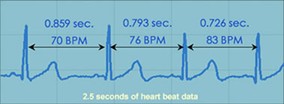
Blood pressure and heart rate are vital signs measured during a routine physical at the doctors office. Heart Rate Variability, on the other hand is not, though should be. Read on to understand the importance of why HRV should be monitored regularly and why the Empowered Brain Program uses HRV from session to session as a critical quantitative measure.
The importance of HRV as a Biometric
HRV plays a significant role in our level of adaptability – physically, cognitively, emotionally – relating to our level of cognitive and physiological resistance in response to environmental demands.
Lower HRV lowers health expression
Lower HRV is linked to conditions including anxiety, depression and sleeping disorders.1
Additionally, HRV is an appropriate tool for detection of diabetes, sleep apnea, myocardial infarction, cardiac arrhythmia, hypertension, renal failure, psychiatric disorders and more.2
Our Empowered Brain Program is entirely focused on cognitive decline and dementia care. This 2023 study published in Frontiers of Neuroscience found that abnormal HRV changes are seen in mild cognitive impairments, dementia, mild traumatic brain injury, migraine, COVID-19, stroke, epilepsy, and psychological conditions.3
At this stage one can see the widespread benefits of effectively addressing low Heart Rate Variability levels. That said, let’s take it a step further…
Higher HRV improves health expression
A systematic review study performed in 2021 found that HRV biofeedback training (improving HRV) showed favorable outcomes and reduction in hypertension and cardiovascular prognosis, inflammatory state, asthma disorders, depression and anxiety, sleep disturbances, cognitive performance and pain.4
HRV and Biological Aging
HRV is naturally higher when we are young and declines as a natural result of the aging process. Considering the abovementioned studies and the connections between low HRV and many different intertwined chronic health disorders – the lower your HRV within age group, the higher one’s general risk of all cause mortality independent of other risk factors.5,6
HRV is not just a stress marker, it is a predictor of survival.
Biological age, youth is therefore well measured and well indicated with HRV.
The Science Explained: HRV and the Heart-Brain Neuraxis
Heart Rate Variability is a measure for neuro-cardiac function, the connections and regulatory signaling between the brain and the heart.
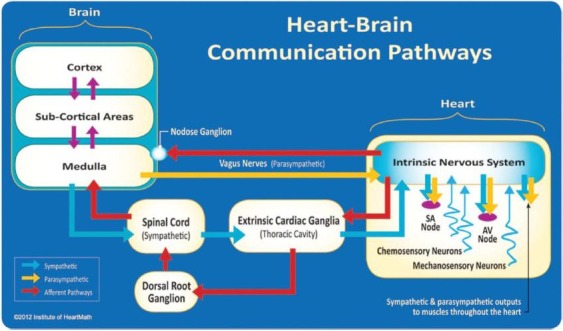
The diversity of conditions influenced by HRV is due to the role the Autonomic Nervous System plays in heart rate. The sympathetic branch speeds up the heart rate and the parasympathetic branch (Vagal) slows it down. Healthy parasympathetic-vagal function increases the level of variance whereas higher sympathetic function reduces it. This is illustrated in Diagram 1 below. 7
How HRV relates to Executive Function, Cognition and Dementia
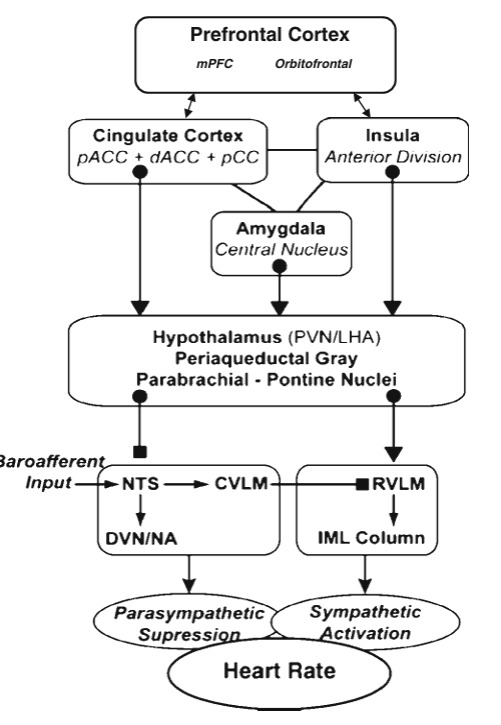
The Heart-Brain neuraxis plays a significant role in executive function and cognition. Much of this has to do with the role of inhibitory pathways directed from the prefrontal cortex to the heart as well as the afferent cardiac pathways that return to the brain.8
While diagram 1 demonstrates the brain heart connections as it relates to HRV. Diagram 28 see right communicates the neurological pathways that prefrontal brain function may influence HRV. The bi-directional pathways between the brain and heart – the neurocardiology allows us to draw important conclusions.
- Mindset and mental emotional training have a positive regulatory effect on heart health and HRV.
- HRV biofeedback training, through physical and breathing exercises, improves the level of cognition and executive function.
Thayer et al. 2009 presented various effects of improved HRV on executive function including: emotional regulation, working memory, attentional set-shifting (multi-tasking with focus / cognitive flexibility). spatial awareness, situational awareness and reaction time.
More recent studies address the salience of utilizing HRV as a biomarker for cognitive decline, future cognition and as a therapeutic target for improving cognition.9,10
As it relates to cognitive decline, dementias and Alzheimer's current studies support the use of HRV as an early diagnostic tool as well as a safe non-invasive and cost effective monitoring tool. The Empowered Brain Program uses HRV monitoring as a valuable quantitative tool with our patients on a daily basis within the 12 month rehabilitative care program.3,11-14 Not only as a health status measure but as a training tool to improve cognitive and many other functions tangibly.
How to Improve Your HRV For Optimal Health and Cognitive Performance
The quality of HRV can be easily improved with regular aerobic and strength training exercises. Generally speaking, everybody should be actively engaged in several days of both forms of training per week.
- 2-3 days of Zone 2 aerobic exercise like running, swimming or cycling at a moderate pace
- 2-3 days of strength training / resistance exercises
Interestingly, through strategic utilization of High Intensity Interval Training (HIIIT) workouts, it is possible to combine the above for optimal time efficiency.
The Empowered Brain Program is proud to partner with HeartMath® technology, enabling patients to engage in targeted breathing protocols supported by real-time HRV biofeedback. This form of guided meditation integrates both emotional and cognitive focus—making it especially effective for building Heart-Brain Coherence, the alignment of rhythmic wave patterns between heart rate variability and brain function.
Breathing-based meditation—such as Box Breathing—is a simple, effective way to stimulate vagal nerve activity and directly improve Heart Rate Variability (HRV). A classic Box Breathing rhythm follows a 4:4:4:4 ratio: inhale for a count of 4, hold for 4, exhale for 4, and hold again for 4. Practicing this for just 5 minutes daily, especially in the evening, can yield measurable benefits.
You can gradually increase the count (e.g., 5:5:5:5) as your breath control improves. Some individuals may prefer the 6:7:8 pattern—inhale for 6, hold for 7, and exhale for 8—which promotes deep relaxation and is especially helpful before sleep.
Disclaimer: The information presented in this article is for educational purposes only and is based on evidence-informed research. It is not intended to diagnose, treat, cure, or prevent any disease. Always consult your qualified healthcare provider before making changes to your health regimen.
- Liu W, Wang S, Gu H, Li R. Heart rate variability, a potential assessment tool for identifying anxiety, depression, and sleep disorders in elderly individuals. Front Psychiatry. 2025 Jan 23;16:1485183. doi: 10.3389/fpsyt.2025.1485183. PMID: 39916745; PMCID: PMC11798971.
- Nayak, S.K.; Pradhan, B.; Mohanty, B.; Sivaraman, J.; Ray, S.S.; Wawrzyniak, J.; Jarzębski, M.; Pal, K. A Review of Methods and Applications for a Heart Rate Variability Analysis. Algorithms 2023, 16, 433. https://doi.org/10.3390/a16090433
- Arakaki X, Arechavala RJ, Choy EH, Bautista J, Bliss B, Molloy C, Wu DA, Shimojo S, Jiang Y, Kleinman MT, Kloner RA. The connection between heart rate variability (HRV), neurological health, and cognition: A literature review. Front Neurosci. 2023 Mar 1;17:1055445. doi: 10.3389/fnins.2023.1055445. PMID: 36937689; PMCID: PMC10014754.
- Fournié C, Chouchou F, Dalleau G, Caderby T, Cabrera Q, Verkindt C. Heart rate variability biofeedback in chronic disease management: A systematic review. Complement Ther Med. 2021;60:102750. Doi:10.1016/j.ctim.2021.102750
- Jarczok MN, Weimer K, Braun C, et al. Heart rate variability in the prediction of mortality: A systematic review and meta-analysis of healthy and patient populations. Neurosci Biobehav Rev. 2022;143:104907. doi:10.1016/j.neubiorev.2022.104907
- Fang SC, Wu YL, Tsai PS. Heart Rate Variability and Risk of All-Cause Death and Cardiovascular Events in Patients With Cardiovascular Disease: A Meta-Analysis of Cohort Studies [published correction appears in Biol Res Nurs. 2020 Jul;22(3):423-425. doi: 10.1177/1099800420909152.]. Biol Res Nurs. 2020;22(1):45-56. doi:10.1177/1099800419877442
- McCraty R, Shaffer F. Heart Rate Variability: New Perspectives on Physiological Mechanisms, Assessment of Self-regulatory Capacity, and Health risk. Glob Adv Health Med. 2015;4(1):46-61. doi:10.7453/gahmj.2014.073
- Thayer JF, Hansen AL, Saus-Rose E, Johnsen BH. Heart rate variability, prefrontal neural function, and cognitive performance: the neurovisceral integration perspective on self-regulation, adaptation, and health. Ann Behav Med. 2009;37(2):141-153. doi:10.1007/s12160-009-9101-z
- Nicolini P, Malfatto G, Lucchi T. Heart Rate Variability and Cognition: A Narrative Systematic Review of Longitudinal Studies. J Clin Med. 2024 Jan 4;13(1):280. doi: 10.3390/jcm13010280. PMID: 38202287; PMCID: PMC10780278.
- Forte G, Favieri F, Casagrande M. Heart Rate Variability and Cognitive Function: A Systematic Review. Front Neurosci. 2019 Jul 9;13:710. doi: 10.3389/fnins.2019.00710. PMID: 31354419; PMCID: PMC6637318.
- Imbimbo C, Spallazzi M, Ferrari-Pellegrini F, Villa A, Zilioli A, Mutti C, Parrino L, Lazzeroni D. Heart rate variability and cognitive performance in adults with cardiovascular risk. Cereb Circ Cogn Behav. 2022 Mar 12;3:100136. doi: 10.1016/j.cccb.2022.100136. PMID: 36324405; PMCID: PMC9616279.
- Attreed A, Morand LR, Pond DC, Sturmberg JP. The Clinical Role of Heart Rate Variability Assessment in Cognitively Impaired Patients and Its Applicability in Community Care Settings: A Systematic Review of the Literature. Cureus. 2024 Jun 5;16(6):e61703. doi: 10.7759/cureus.61703. PMID: 38975380; PMCID: PMC11226213.
- Kim MS, Yoon JH, Hong JM. Early differentiation of dementia with Lewy bodies and Alzheimer's disease: Heart rate variability at mild cognitive impairment stage. Clin Neurophysiol. 2018 Aug;129(8):1570-1578. doi: 10.1016/j.clinph.2018.05.004. Epub 2018 May 29. PMID: 29883835.
- Kasanuki K, Iseki E, Fujishiro H, Ando S, Sugiyama H, Kitazawa M, Chiba Y, Sato K, Arai H. Impaired heart rate variability in patients with dementia with Lewy bodies: Efficacy of electrocardiogram as a supporting diagnostic marker. Parkinsonism Relat Disord. 2015 Jul;21(7):749-54. doi: 10.1016/j.parkreldis.2015.04.024. Epub 2015 May 1. PMID: 25962552.

Comments are closed.