Understanding the role of Thiamin / Benfotiamine
A vitamin that removes Amyloid Beta plaques, supports cognition and neurogenesis…
Thiamin or Vitamin B1 is an essential vitamin required for brain function, energy production and metabolism, cardiovascular and muscular health as well as antioxidation. While thiamin is present in many foods including whole grains, meat and fish it is impossible to consume and absorb a sufficient amount for effectively addressing neurodegenerative conditions like cognitive decline, dementia, Alzheimer's and Parkinson’s disease. Benfotiamine, a synthetic form of B1, is increasingly recognized as a natural neuroprotective agent, offering multiple mechanisms to slow or even reverse the cognitive impacts of Alzheimer’s disease.
The Role of Thiamine in Brain Health
In fact, some health conditions caused by chronic thiamine deficiency include dysfunctions in glucose metabolism and mitochondrial function, which can lead to Wernicke’s encephalopathy or Wernicke–Korsakoff syndrome. Long-term thiamine deficiency may also result in heart failure, neuropathy, ataxia (balance problems), confusion, and delirium.¹
Deficiencies of thiamine are notably observed in Alzheimer’s, Parkinson’s, and Huntington’s diseases. Additionally, alcoholism remains the primary cause of thiamine deficiency. That does not mean that alcoholism plays a direct role here; alcohol intake does however cause a loss of B vitamins from the body.
Some time ago, I read about the late Dr. Antonio Constantini and his groundbreaking clinical work using high dose Thiamin with individuals living with Parkinson’s disease and other debilitating health conditions. The science backing his work piqued my interest and I started to dig deeper.
Thiamin has a diverse physiological role
Thiamin plays diverse physiological roles in the body. As a coenzyme, Thiamin is necessary in the metabolism of carbohydrates, fats and proteins. It is responsible for mitochondrial function, energy production, glucose utilization, amino acid synthesis, cellular respiration and fatty acid oxidation. Lastly, Thiamin plays a critical role in the central nervous system where it is involved in the production of various neurotransmitters – the chemical messengers through which nerve signaling occurs. The image below1 demonstrates Thiamin’s diverse roles in human physiology.
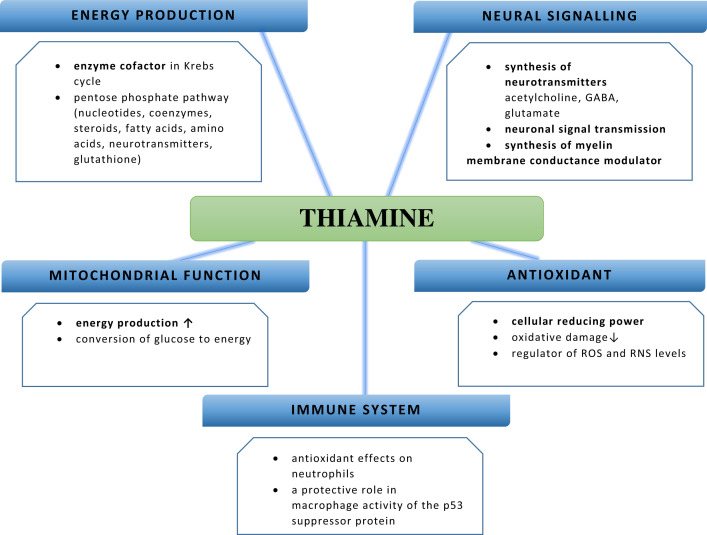
Thiamin deficiency therefore has widespread impacts across critical systems causing dysfunctions in energy production and glucose utilization, synthesis and metabolism involving fatty acids, protein, neurotransmitters, cellular antioxidation and more. Neurodegeneration is the culminating end stage of the abovementioned effects.
Working with cognitive decline, dementia, Alzheimer's and other neurodegenerative conditions require heavy artillery when it comes to nutritional support. Years of damage involve multiple layers of involvement requiring attention. Additionally, significant brain-body fatigue / exhaustion limits the individual’s resilience to handle minimal therapeutic interventions without exacerbating fatigue. Thiamin plays an important role in this scenario.
Benfotiamine is a highly absorbable form of Thiamin
The biggest problem with supplementing Thiamin is its poor absorption. Basically, the body cannot absorb high amounts of Thiamin in its natural form. The research shows that Benfotiamine, a synthetic form of Thiamin, is highly bioavailable. Based on the research presented below, Benfotiamine is safe and has no adverse side effects. Its diverse effects make it appropriate for natural support for the healthy aging brain as well as more significant clinical requirements.
The below section highlights findings from recent studies on Benfotiamine.
Clinical Evidence Supporting Benfotiamine
Benfotiamine's Research in Alzheimer's Disease
A 2020 randomized, placebo-controlled clinical trial published in the Journal of Alzheimer’s Disease found that benfotiamine efficiently reduces both clinical and biological pathologies associated with Alzheimer’s disease. This includes impaired cognition, amyloid beta plaques, neurofibrillary tangles, glucose metabolism dysfunction, inflammation, oxidative stress, and the buildup of advanced glycation end products (AGEs).²
In addition to its promise as a therapy for Alzheimer’s and Parkinson’s diseases, benfotiamine’s protective effect against neurofibrillary tangles in tau pathologies also makes it a potential candidate for treating frontotemporal dementia and progressive supranuclear palsy.³
One year later, a study published in the International Journal of Molecular Sciences found that benfotiamine improved cognition in people living with mild Alzheimer’s disease — with no reported adverse effects.⁴
More recently, a 2023 study published in Heliyon describes benfotiamine as an accessible, off-the-shelf agent that supports nerve health, promotes healthy aging, and helps maintain glucose metabolism.⁵
The 2020 Journal of Alzheimer’s Disease study echoes these findings, highlighting consistent clinical benefits across the literature. But how can one vitamin — or more specifically, its synthetic form — exert such a significant impact? Two key factors lie in its role in glucose metabolism and its powerful anti-inflammatory capacity.
How Benfotiamine is Neuroprotective in Alzheimer’s disease
Glucose Metabolism and Brain Health
Brain cells require 3 things to function properly and express health- oxygen, glucose and activation. Glucose metabolism in the brain is significantly impacted in Alzheimer's disease. Recall from the above diagram that Thiamin or Vitamin B1 plays a critical role in glucose metabolism? Faulty glucose utilization results in neuronal degeneration.
A 2010 study published in Brain demonstrated that Benfotiamine, with significantly higher bioavailability than thiamine, improves spatial memory, reduces amyloid plaques as well as phosphorylated tau levels in cortical regions of mice brains.6 This may be because B1 is a critical component for glucose metabolism and energy production required for normal cell and neuronal functioning. The loss of which leads to general decay in function.
Benfotiamine’s Anti-inflammatory Benefits for Brain Health
Benfotiamine is a significant natural support for neuroimflammation, demonstrating antioxidant and anti-inflammatory effects in the brain (specifically in glial cells), immune cells,⁷ and muscle tissue.⁸
Glial (microglial) cells serve as the central nervous system’s immune system. While they play a vital role in neural repair after injury, their overactivation can contribute to neurodegenerative processes.
Research has shown that benfotiamine can “remodel” activated glial cells back to a non-active state. It also reduces the production of pro-inflammatory mediators, including inducible nitric oxide synthase (iNOS) and nitric oxide, COX-2, tumor necrosis factor alpha (TNF-α), and IL-6, while decreasing the activity of nuclear factor kappa B (NF-κB), another key pro-inflammatory factor. Lastly, benfotiamine activates the anti-inflammatory cytokine IL-10.⁹
As an anti-inflammatory agent, benfotiamine has also been shown to improve complications related to diabetes.⁵ One notable example is its ability to reduce advanced glycation end products (AGEs), which cause significant vascular complications in diabetes.¹⁰
Anti-inflammatory effects are Neuroprotective
- Reduces amyloid beta plaques2
- Protects against stress induced inhibition of neurogenesis in the hippocampus.11
- Improves motor function and protects dopamine producing neurons in Parkinson’s disease12
- Protects against the generation of neurofibrillary tangles (NFTs) in a tauopathy mouse model according to a 2018 study published in Human Molecular Genetics3
Conclusion
This amazing synthetic form of vitamin B1 is an essential for countless cellular and neurological processes. It has well-established research on its protective and therapeutic roles in dementia and no adverse side effects. We find it essential as a natural support for neuroinflammation in managing cognitive decline, dementia and Alzheimer's disease. If you are exploring an integrative multidisciplinary approach for rehabilitating dementia click on our 12 month Empowered Brain Program. For more information on natural neurological support have a read through our articles on Neurogenesis and Brain Derived Neurotrophic Factor and the adaptogenic properties of Reishi Mushrooms.
Order Benfotiamine here
Click here to order Benfotiamine in powder form which you can easily dissolve in a glass of water. To be used appropriately with your physician’s guidance only.
Disclaimer. The information represented in this article is meant to provide concepts from evidence based research. It is not intended to treat or diagnose any health condition. For appropriate treatment methods please contact your healthcare provider.
- Mrowicka M, Mrowicki J, Dragan G, Majsterek I. The importance of thiamine (vitamin B1) in humans. Biosci Rep. 2023;43(10):BSR20230374.
- Gibson GE, Luchsinger JA, Cirio R, et al. Benfotiamine and Cognitive Decline in Alzheimer's Disease: Results of a Randomized Placebo-Controlled Phase IIa Clinical Trial. J Alzheimers Dis. 2020;78(3):989-1010.
- Tapias V, Jainuddin S, Ahuja M, et al. Benfotiamine treatment activates the Nrf2/ARE pathway and is neuroprotective in a transgenic mouse model of tauopathy. Hum Mol Genet. 2018;27(16):2874-2892. doi:10.1093/hmg/ddy201
- Sambon M, Wins P, Bettendorff L. Neuroprotective Effects of Thiamine and Precursors with Higher Bioavailability: Focus on Benfotiamine and Dibenzoylthiamine. Int J Mol Sci. 2021;22(11):5418. Published 2021 May 21.
- Bozic I, Lavrnja I. Thiamine and benfotiamine: Focus on their therapeutic potential. Heliyon. 2023;9(11):e21839. Published 2023 Nov 7.
- Xiaoli Pan, Neng Gong, Jing Zhao, Zhe Yu, Fenghua Gu, Jia Chen, Xiaojing Sun, Lei Zhao, Meijing Yu, Zhiru Xu, Wenxin Dong, Yan Qin, Guoqiang Fei, Chunjiu Zhong, Tian-Le Xu, Powerful beneficial effects of benfotiamine on cognitive impairment and β-amyloid deposition in amyloid precursor protein/presenilin-1 transgenic mice, Brain, Volume 133, Issue 5, May 2010, Pages 1342–1351
- Bozic I, Lavrnja I. Thiamine and benfotiamine: Focus on their therapeutic potential. Heliyon. 2023;9(11):e21839. Published 2023 Nov 7.
- Coles CA, Woodman KG, Gibbs EM, Crosbie RH, White JD, Lamandé SR. Benfotiamine improves dystrophic pathology and exercise capacity in mdx mice by reducing inflammation and fibrosis. Hum Mol Genet. 2024;33(15):1339-1355.
- Bozic I, Savic D, Laketa D, et al. Benfotiamine attenuates inflammatory response in LPS stimulated BV-2 microglia. PLoS One. 2015;10(2):e0118372. Published 2015 Feb 19.
- Raj V, Ojha S, Howarth FC, Belur PD, Subramanya SB. Therapeutic potential of benfotiamine and its molecular targets. Eur Rev Med Pharmacol Sci. 2018;22(10):3261-3273.
- Vignisse J, Sambon M, Gorlova A, et al. Thiamine and benfotiamine prevent stress-induced suppression of hippocampal neurogenesis in mice exposed to predation without affecting brain thiamine diphosphate levels. Mol Cell Neurosci. 2017;82:126-136.
- Wang K, Han C, Yang J, et al. Benfotiamine protects MPTP-induced Parkinson's disease mouse model via activating Nrf2 signaling pathway. PLoS One. 2024;19(7):e0307012. Published 2024 Jul 23.
